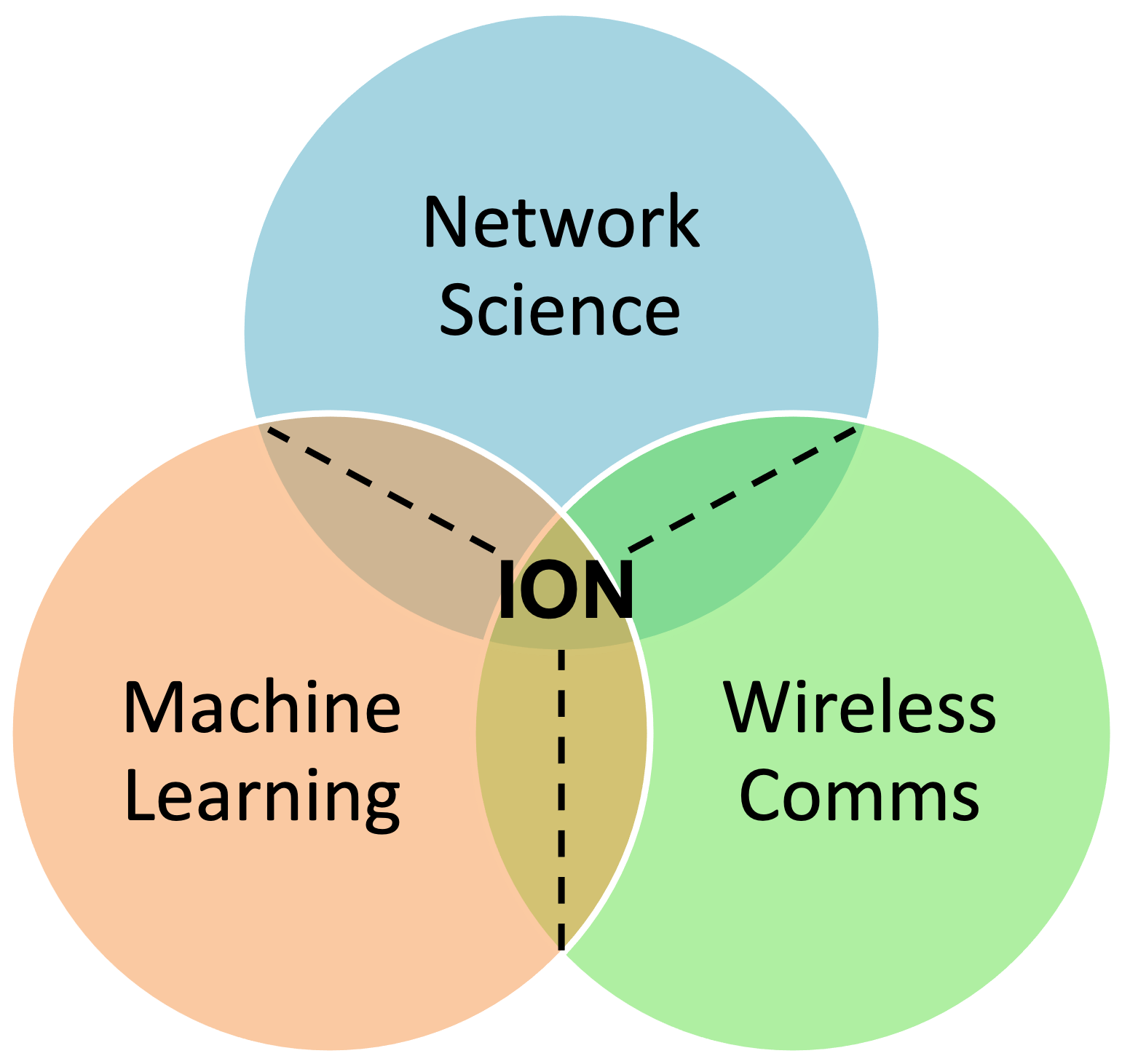
The Intelligence Optimization for Networks (ION) Lab at Purdue University conducts research at the intersection of network science/optimization and machine learning. This includes devising techniques for intelligence management in contemporary networked systems (i.e., networks for learning), and data-driven methodologies to optimize/defend how wireless networks operate (i.e., learning for networks).
ION produces methodologies spanning both communication network architectures (e.g., fog/edge computing, 5G/6G/NextG wireless, IoT) and certain social applications that run on top of these architectures (content delivery, online education, recommendation systems). Most of our efforts include significant theoretical (e.g., convergence analysis) and experimental (e.g., evaluations on real-world datasets) components.
The following summarizes a few key thrusts of ION's current research, with selected publications in each case. More publications can be found here.
T1: Distributed Learning over Heterogeneous Edge Networks
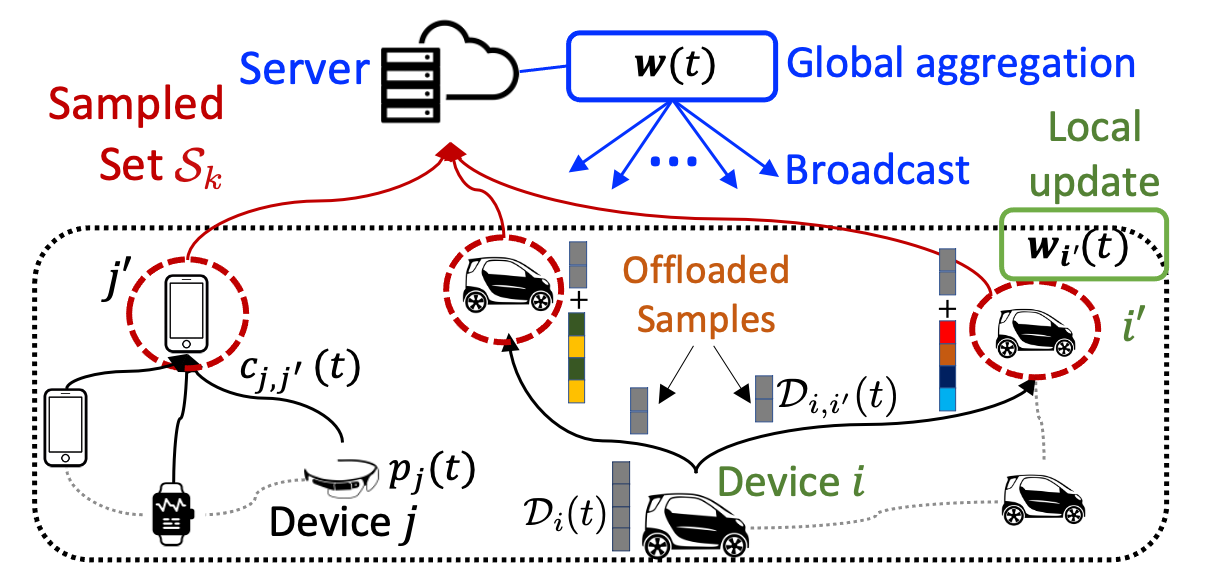
Federated learning has emerged as a popular technique for distributing the training of a machine learning model across a set of intelligent devices. In practice, these are often wireless edge/IoT devices, which are heterogeneous in their communication and computation resources, and tend to have diverse local dataset statistics. These heterogeneity factors must be carefully accounted for in optimizing the training process based on both learning quality and resource efficiency metrics.
Architecturally, we consider how to migrate from the star topology of conventional federated learning to more distributed topologies that can manage these different dimensions of heterogeneity. In particular, we can blend the local update/global aggregation framework of federated learning with techniques such as intelligent device sampling (communication/computation heterogeneity) and direct device-to-device (D2D) communications (statistical diversity). We have developed new analytical results for model convergence based on these techniques, and employed them as the basis for control algorithms that optimize learning. Our experiments have demonstrated e.g., 50% faster convergence speed with a 3x improvement in resource efficiency.
Select/Recent Publications
- S. Azam, S. Hosseinalipour, Q. Qiu, C. Brinton. Recycling Model Updates in Federated Learning: Are Gradient Subspaces Low-Rank? International Conference on Learning Representations (ICLR), 2022.
- S. Wang, S. Hosseinalipour, C. Brinton. Multi-Source to Multi-Target Decentralized Federated Domain Adaptation. IEEE Transactions on Cognitive Communications and Networking, 2024.
- W. Fang, D. Han, L. Yuan, S. Hosseinalipour, C. Brinton. Federated Sketching LoRA: On-Device Collaborative Fine-Tuning of Large Language Models. International Conference on Machine Learning (ICML), 2026.
T2: Orchestrating Model Training over Large-Scale Networks
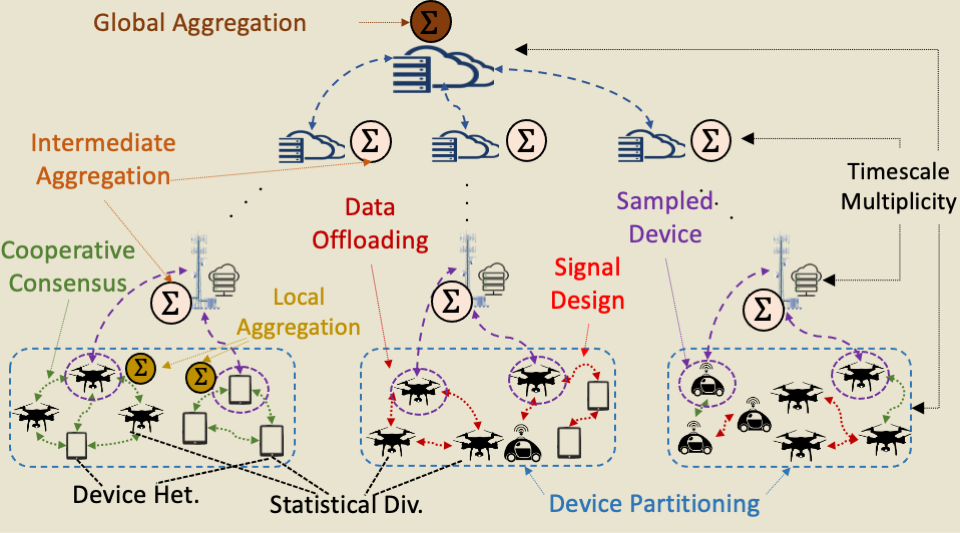
Another key challenge faced by existing distributed computing techniques is the volume and geographical span of the edge. A datacenter coordinating a computing task may be removed from the devices by several layers of a complex network hierarchy. Fog has emerged as an architecture for distributing network data processing tasks across this cloud-to-things continuum. Machine learning tasks require careful consideration in fog computing, especially when coupled with the challenges mentioned in the previous thrust.
To address this, we have been developing fog learning, a new paradigm for intelligently distributing machine learning across fog networks while accounting for heterogeneity and scalability properties. Fog learning aims to adapt device, fog, and cloud-level decision-making to jointly optimize model quality, service latency, and energy consumption metrics. In one case, we are considering how to augment federated learning with localized model aggregations throughout the fog hierarchy. To do so, we have experimented with novel local aggregation approaches via cooperative consensus formation within D2D-enabled local networks. Our resulting adaptive orchestration algorithms achieve the convergence speed of centralized training, with experiments demonstrating up to 50% reductions in energy consumption and service delay for the same model quality.
More information on our investigations into fog learning can be found at my NSF CAREER project webpage.
Select/Recent Publications
- S. Hosseinalipour, S. Azam, C. Brinton, N. Michelusi, V. Aggarwal, D. Love, H. Dai. Multi-Stage Hybrid Federated Learning over Large-Scale D2D-Enabled Fog Networks. IEEE/ACM Transactions on Networking, 2022.
- D. Han, S. Hosseinalipour, D. Love, M. Chiang, C. Brinton. Cooperative Federated Learning over Ground-to-Satellite Integrated Networks: Joint Local Computation and Data Offloading. IEEE Journal on Selected Areas in Communications, 2023.
- W. Fang, D. Han, E. Chen, S. Wang, C. Brinton. Hierarchical Federated Learning with Multi-Timescale Gradient Correction. Conference on Neural Information Processing Systems (NeurIPS), 2024.
T3: Learning-Based Wireless Protocol Optimization
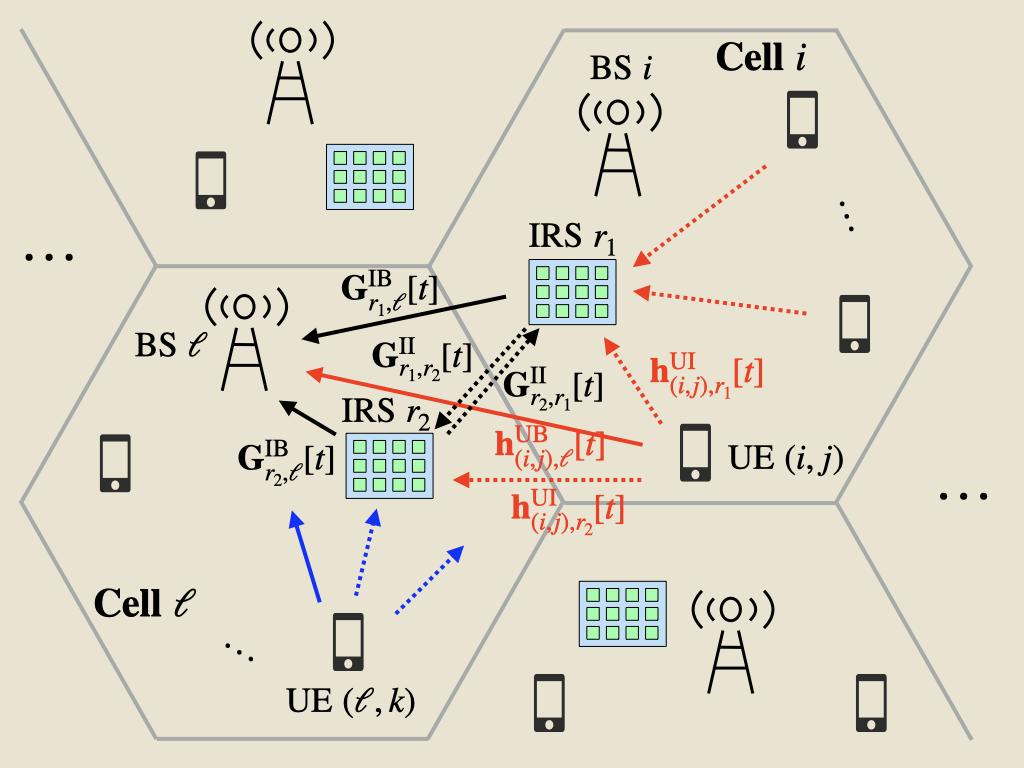
The convergence of today's wireless communication protocols with intelligent user applications is generating a plethora of data about network operation. The availability of these measurements presents a novel opportunity to re-examine existing network protocols from a data-driven perspective, and to develop intelligent protocols for NextG wireless services at the edge. While each use-case presents its own interesting questions, a few fundamental challenges exist: physical-layer measurement noise, protocol delay sensitivity, and adversarial threats.
In investigating different use-cases we have been pursuing a cross-layer wireless learning approach, where learning of physical and link-layer processes takes place across the network protocol stack. In one line of work, we have been investigating wireless signal detection techniques, including building robustness to adversarial threats through adapting between time and frequency domain representations of input signals. Another direction of work has been considering MIMO beamforming design for communication and computation overhead minimization, leading to provably optimal beamformer strategies. Yet another direction has been deep learning coding approaches for building robustness in noisy wireless feedback channels.
Select/Recent Publications
- J. Kim, S. Hosseinalipour, A. Marcum, T. Kim, D. Love, C. Brinton. Learning-Based Adaptive IRS Control with Limited Feedback Codebooks. IEEE Transactions on Wireless Communications, 2022.
- J. Kim, T. Kim, D. Love, C. Brinton. Robust Non-Linear Feedback Coding via Power-Constrained Deep Learning. International Conference on Machine Learning (ICML), 2023.
- S. Wagle, A. Malhotra, S. Hamidi-Rad, A. Sant, D. Love, C. Brinton. Unlocking Realism and Interpretability in Wireless Channel Synthesis: A Physics-Guided Generative Approach. IEEE Transactions on Wireless Communications, 2026.
T4: User Service Personalization in Socio-Technical Networks
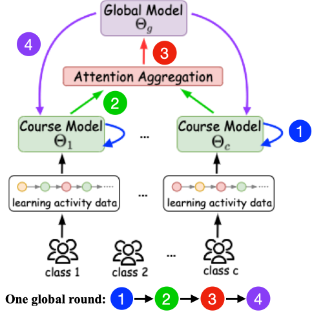
Contemporary social and communication networks support a plethora of high fidelity end-user services, driven recently by large language models. The fine-granular behavioral data (e.g., video-watching clickstream measurements) generated as users interact with these services (e.g., online videos) presents an opportunity to optimize application delivery with AI embedded in user devices. In doing so, we must also preserve the privacy of sensitive data.
We are developing a suite of techniques that personalize AI-driven services to end user behavior and device resources. In one direction, we are adapting our distributed learning tools to facilitate learning analytics in online education, including federated meta-learning methodologies that personalize user models based on student subgroups. Additionally, we have been developing foundation model task routing techniques that decide where, when, and how a given user query should be served. Yet another direction involves human-in-the-loop reinforcement learning for local model fine-tuning.
Select/Recent Publications
- C. Brinton, S. Buccapatnam, L. Zheng, D. Cao, A. Lan, F. Wong, S. Ha, M. Chiang, H.V. Poor. On the Efficiency of Online Social Learning Networks. IEEE/ACM Transactions on Networking, 2018.
- Y. Chu, D. Han, S. Hosseinalipour, C. Brinton. Rethinking the Starting Point: Collaborative Pre-Training for Federated Downstream Tasks. Association for the Advancement of Artificial Intelligence (AAAI), 2025.
- L. Yuan, D. Han, S. Wang, C. Brinton. Device-Cloud Collaborative LLM Inference with Multi-Modal, Multi- Task, Multi-Turn Conversations. IEEE Transactions on Networking, 2026.
Current Personnel
Postdoctoral Research Associates
- Mehdi Karbalayghareh
- Ziqiao Zhang
PhD Students
- Shams Azam
- Evan Chen
- Shengli Ding
- Tom Fang
- Surojit Ganguli
- Xiaoyan Ma
- David Nickel
- Kareem Olama
- Adam Piaseczny
- Ananth Rajagopalan
- Abhishek Rajasekaran
- Liangqi Yuan
- Shahryar Zehtabi
- Jianing Zhang
- Yinan Zhou
- George Ziavras
Masters Students
- Joseph Lee
- Juanes Vargas
Undergraduate Student Researchers
- Jonah McFadden
- Tobias Tillett
- Ryan Wans
Sponsors